
Guide
Choosing the right workshop press — 20, 30, 50 or 100 tonnes?
Six Mammuth presses, one job: pressing things in and out without hammer and hope. Here is what the numbers mean, which press suits which workshop, and what to do when the press cannot reach.
If you read one thing
A workshop press is chosen by three things: how many tonnes the heaviest jobs need, how large the parts going into the frame are, and how you want to drive the pump. Our Mammuth range runs from 20 to 100 tonnes. Tonnes cannot be worked out in advance: a rusted wheel bearing on a passenger car can easily take 40–50 tonnes, while the same bearing on a new car goes with a fraction. So choose the press by the heaviest job you can imagine, with margin — not by the most common one. A hand pump is fine for the press used now and then; a foot pedal and air are worth it for the press used every day, because both hands stay free. Where the press cannot reach, a flat cylinder does the same job at 47 to 100 mm height — with its own 700-bar pump.
Updated 12 September 2026
What a workshop press does — and what the numbers mean
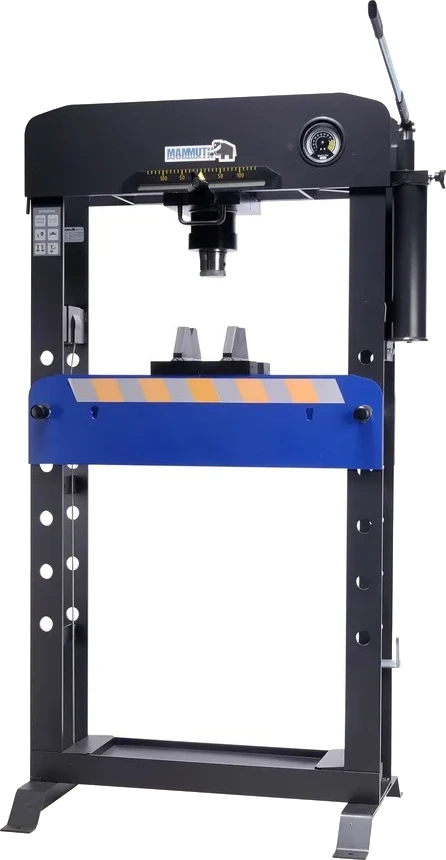
A workshop press is a frame, a table and a hydraulic cylinder pushing down towards the table. The pump builds pressure in the oil, the cylinder turns it into force. That is all. But it is force enough to press bearings, bushings, shafts and pins in and out, straighten bent parts, and bend tube — jobs otherwise done with a sledgehammer and ruined parts.
Tonnes is the largest force the cylinder can give. It is not the force you use daily; most jobs take a fraction. The number says how much margin you have.
Stroke is how far the cylinder can travel in one pumping. To push a long shaft out of a hub the stroke must be long enough — otherwise you stop, pack underneath, and pump again.
Working height is the distance from the table to the cylinder. The table moves in fixed steps (six on all our presses), so minimum and maximum height say what fits.
Table width says how large a part fits between the frame legs. A hub bearing is small. A rear axle is not.
Two-stage pump is on every Mammuth press: the first stage moves the cylinder quickly down to the part, the second gives small, controlled movements at full force. It is the difference between pumping twenty times to reach the part, and pumping twice.
Pressure gauge shows what the job actually needs. If the needle heads for the top on a job that should be easy, something is sitting crooked — stop and check, instead of pressing harder.
How many tonnes do you need?
There is no table that says "wheel bearing = so many tonnes". The force depends on fit, size, corrosion and whether the part sits straight — and corrosion is the great unknown. A wheel bearing on a new car comes out with a few tonnes. The same bearing after fifteen salted winters can easily take 40–50 tonnes. Nobody sees the difference until the press is on it.
So the rule is simple: choose the press by the heaviest job you can imagine, with margin — not by the most common one. A press working at half force gives control and a long life. A press worked to its maximum gives neither, and a job it cannot do stays undone.
What separates our presses is therefore not first of all which vehicles they suit, but how much margin you buy, and how large a part fits:
20 tonnes (SP20XH, SP20XHM) — compact, hand pump, 540 mm table. For the workshop that uses the press now and then, and sends the heavy jobs elsewhere.
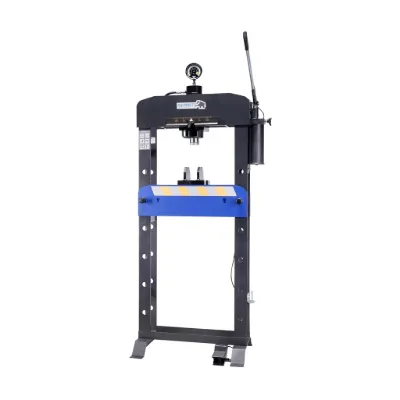
30 tonnes (SP30XHAM, SP30HAMB) — air-hydraulic with foot pedal. Same table width as the 20-tonner, or 750 mm on the HAMB model. For the workshop that uses the press every day and wants its hands free.
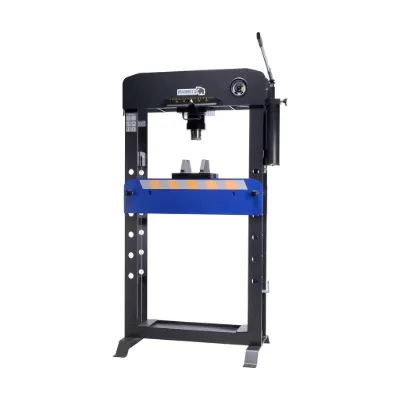
50 tonnes (SP50XHM) — hand pump, 750 mm table. The margin that takes the rusted bearing, heavy axles and straightening bent parts, which takes far more than pressing a bearing.
100 tonnes (SP100XHAM) — air-hydraulic with foot pedal, 850 mm table, 300 mm stroke. For large bearings, press fits in steel and straightening thick sections.
The six presses
| SP20XH · 20 tonnes | Hand pump · 540 mm table · 180 mm stroke · V-block included |
|---|---|
| SP20XHM · 20 tonnes | Hand pump · 540 mm table · 180 mm stroke · working height 48–958 mm · side-adjustable cylinder |
| SP30XHAM · 30 tonnes | Air + foot pedal (8–12 bar) · 540 mm table · 180 mm stroke · working height 75–915 mm |
| SP30HAMB · 30 tonnes, wide table | Air + foot pedal · 750 mm table · 220 mm stroke + 75 mm spindle · table winch · 8 press pins |
| SP50XHM · 50 tonnes | Hand pump · 750 mm table · 200 mm stroke · working height 120–700 mm · hand wheel |
| SP100XHAM · 100 tonnes | Air + foot pedal · 850 mm table · 300 mm stroke · working height 185–700 mm · hand crank |
Hand or air — the real choice
All the Mammuth presses have a hydraulic cylinder. The difference is what drives the pump.
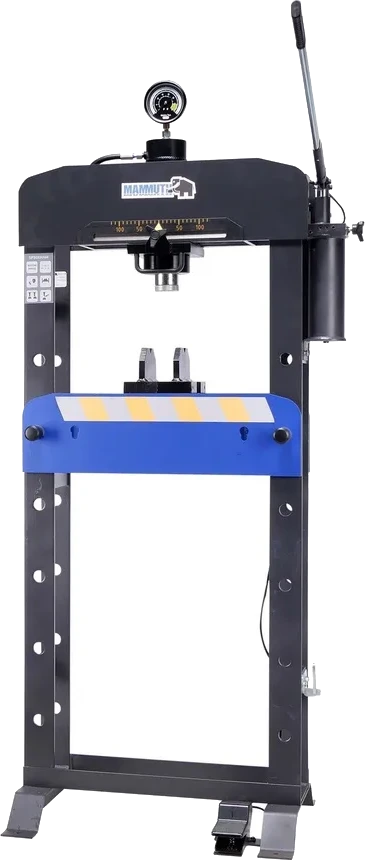
Hand pump (SP20XH, SP20XHM, SP50XHM): you pump with a lever. Simple, no connection, works anywhere. The drawback is that one hand pumps while the other holds the part — and a heavy job takes many strokes. For the press used a few times a week, that is perfectly fine.
Air-hydraulic with foot pedal (SP30XHAM, SP30HAMB, SP100XHAM): compressed air from the compressor (8–12 bar) drives the pump, and you control it with your foot. Both hands are free to hold the part straight and feel when it seats. It is safer and faster, and that is why the busy workshops choose it. The hand pump is still there as a backup if the air is off.
What separates a good press from a cheap one
Side-adjustable cylinder. On all our presses except the SP20XH the cylinder slides sideways along a scale. So you move the cylinder to the part, instead of balancing the part under the cylinder. On awkward parts it is the difference between hit and miss.
A table that is easy to move. A press table is heavy. The 50- and 100-tonners have a crank or hand wheel, the SP30HAMB a winch: you put the part on the lowest step and wind the table up to working height. Without it you lift the table yourself.
Interchangeable press head. All our presses have it. You mount press pins, drifts and accessories straight on the cylinder instead of stacking loose pieces in between.
Press blocks and V-block. Included. The V-block keeps round stock centred; the press blocks give a face to press against without damaging the table.
Fully welded frame. A bolted frame gives and twists under load. All the Mammuth presses are fully welded, and that is why they stand up to straightening work.
When the press cannot reach: flat cylinders
A press requires the part to come to the press. Much of it does not: a bearing in a machine bolted to the floor, a shaft in a frame, something that has to lift a few millimetres to get the shim under. Then you turn it around and bring the force to the part.
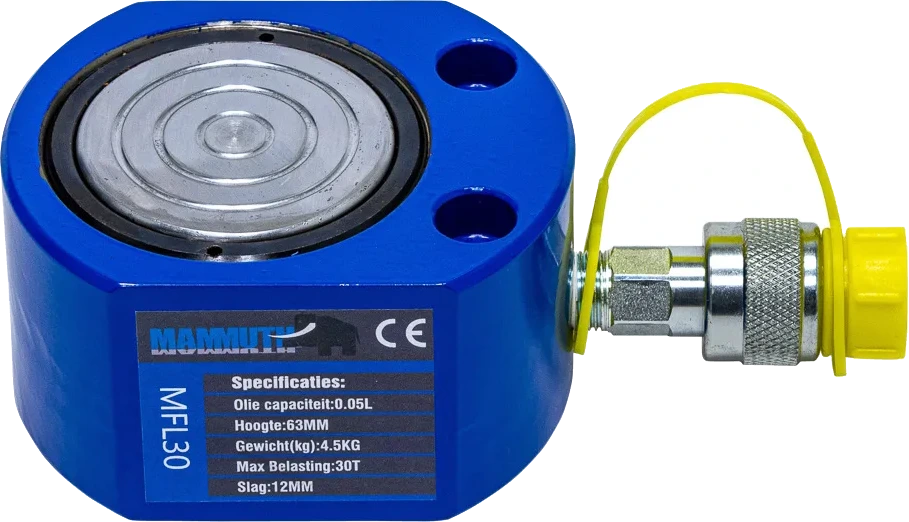
Mammuth’s flat cylinders are hydraulic cylinders low enough to get into tight spaces — from 47 mm tall on the 10-tonner to 100 mm on the 200-tonner. They are driven by a separate 700-bar pump through a hose, and the piston is chromed and retracts by itself when the pressure is released.
There are two kinds: single cylinders have a short stroke (11–18 mm) and the lowest height. They are for jobs where the part only has to move a little: lift, clamp, push a bushing out a few millimetres. Double cylinders (the D versions) have a longer stroke, 25–75 mm, and are almost as low when collapsed. Choose double when the part has to move more than a couple of centimetres.
The force is chosen as for the press: with margin. And because the cylinder often sits under something heavy, the same rule as for jacks applies: the cylinder lifts, it does not hold. Secure the load with a stand or block before anyone goes under.
To be honest: the pump that drives them is not in our catalogue today. If you need cylinder and pump together, ask us and we will put a set together.
Flat cylinders — height and stroke
| 10 tonnes | MFL10: 47 mm tall, 11 mm stroke · MFL10D: 47 mm, 25 mm stroke |
|---|---|
| 20 tonnes | MFL20: 52 mm, 11 mm stroke · MFL20D: 52 mm, 26 mm stroke |
| 30 tonnes | MFL30: 63 mm, 12 mm stroke · MFL30D: 63 mm, 53 mm stroke |
| 50 tonnes | MFL50: 69 mm, 16 mm stroke · MFL50D: 69 mm, 64 mm stroke |
| 100 tonnes | MFL100: 86 mm, 16 mm stroke · MFL100D: 86 mm, 75 mm stroke |
| 200 tonnes | MFL200: 100 mm, 18 mm stroke |
| All | Max 700 bar · chromed piston · automatic return |
Watch out for
The part must sit straight. The most common press accident is a part that sits crooked, builds up force, and lets go. Centre it under the cylinder, use the V-block on round stock, and watch the gauge: if it climbs fast on an easy job, something is wrong.
Safety glasses, always. Hardened steel that fails under press fails in pieces.
Not above maximum. If the part will not move, the press is not what needs pushing harder. Check the setup, use heat or a puller, or a larger press.
Do not leave the part under pressure. Release the pressure when you leave the press. A cylinder can creep, and a part under load is a part that can go.
Oil and air. The hand pumps use OKCH68 hydraulic oil; keep the level up. Air-hydraulic presses want dry, clean air at 8–12 bar — a water separator on the line saves the pump.
Headroom. The table goes up to 958 mm on the 20-tonner and the frame is tall. Measure before you order, especially under low ceilings.
Not sure how many tonnes you need?
Tell us the heaviest job the press will do, and how often. We will say which one fits — and whether it is the press or a flat cylinder you really need.
Contact usThe equipment this is about
SKU MAMMFL30
Flat cylinder 30 ton stroke 12mm
Flat cylinder This cylinder is suitable for working in tight spaces. The surface of the plunger is finished with a chrome plate. Plunger has the function of retracting automatically.
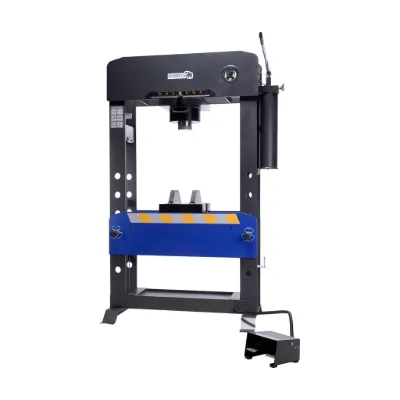
SKU MAMSP100XHAM
Workshop press air hydraulic with foot pedal 100 tons
Mammuth workshop press with a fully welded frame, integrated pressure gauge and air-hydraulic operation via foot pedal. The press features a two-stage pump for fast approach and precise pressing. The worktable is adjustable to 6 heights using a hand winch, and the cylinder can be shifted sideways with a scale for accurate positioning. An interchangeable pressing adapter allows easy fitting of other attachments. The pneumatic foot pedal keeps both hands free during operation.
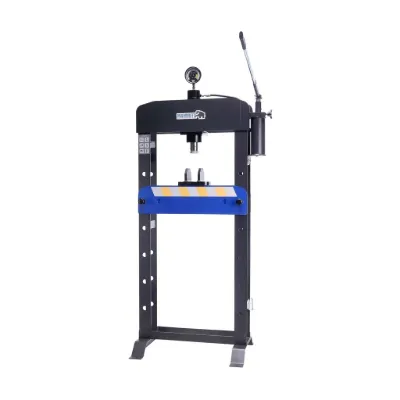
SKU mamSP20XH
Workshop press hydraulic 20 tons
Mammuth hydraulic workshop press suitable for mounting bearings, pressing in shafts and bolts, bending pipes and other press work requiring great force. The frame is fully welded and solid. The pressure in kilograms can be clearly read on the pressure gauge. The hydraulic cylinder is equipped with an interchangeable press head and an integrated hydraulic two-stage pump. The two-stage system provides a large stroke at low back pressure and a small controllable stroke at higher back pressure, enabling accurate press work. Supplied as standard with two multifunctional press blocks including a V-block.
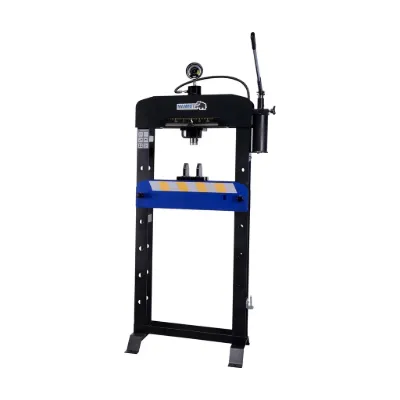
SKU MAMSP20XHM
Workshop press hydraulic 20 tons
Mammuth bearing press intended for installing bearings, pressing shafts and bolts, and other tasks requiring precise pressing. The frame is fully welded and the press features a two-stage pump for fast and precise operation. The workbed height is adjustable to 6 different positions, and the cylinder can be shifted sideways using a scale for accurate positioning. The press adapter is interchangeable to allow use of other attachments. Includes 2 press blocks.
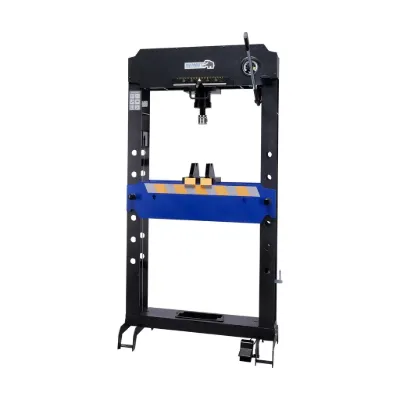
SKU MAMSP30HAMB
Workshop press Wide Work bed air hydraulic with foot pedal 30 tons
This Mammuth bearing press is designed for installing bearings, pressing shafts and bolts, and other precise pressing tasks. The wide 750 mm workbed makes it suitable for larger workpieces as well. The fully welded frame features an integrated pressure gauge. The press is supplied with 2 press blocks. A two-stage pump provides fast initial movement followed by precise pressing. The workbed is easily adjusted with a hand winch at 6 different heights. The cylinder is side-adjustable and extendable via the screw spindle for precise positioning. The quick-change press head includes 8 pressing pins. A pneumatic foot pedal enables effortless operation and keeps both hands free.
SKU MAMSP30XHAM
Workshop press air hydraulic with foot pedal 30 tons
This Mammuth bearing press is suited for installing bearings, pressing shafts and bolts, and other precise pressing tasks. The press features a fully welded frame and is supplied with 2 press blocks. The two-stage pump provides fast initial travel followed by precise pressing. The workbed is easily adjusted and secured at 6 different heights. The cylinder is side-adjustable with a scale for accurate positioning, and the press adapter is interchangeable for use with other attachments. A pneumatic foot pedal enables hands-free operation. Air connection 1/4 NPT, working pressure 8–12 bar.
SKU MAMSP50XHM
Workshop press hydraulic 50 tons
Mammuth hydraulic workshop press with a 50-ton capacity, fully welded frame, integrated pressure gauge, and two-stage pump for fast and precise pressing. Suitable for installing and removing bearings, straightening metal parts, and pressing shafts and bolts. The workbed height is easily adjustable via a hand winch at 6 different positions. The cylinder is side-adjustable with a scale for precise positioning, and the press adapter is interchangeable for use with other attachments. Includes 2 press blocks.