
Guide
Break-in oil — why and how
The first running hours decide how good the engine will be for the rest of its life. The right oil in the right order is half the job.
If you read one thing
A freshly rebuilt or newly built engine should be run in on break-in oil: mineral-based, high in zinc (ZDDP) and free of the friction modifiers modern oil is full of. The rings need controlled friction to seat against the cylinder wall — ordinary oil is simply too slippery. Break in at varying revs, never idle for the first minutes, change the oil early, and then switch to your running oil.
Updated 29 August 2026
What breaking in actually does
In a new or freshly rebuilt engine, nothing is "finished" from the factory or the machine shop. The piston rings must lap themselves against the honing pattern in the cylinder wall until they seal — that is what gives compression and low oil consumption for the rest of the engine's life. The cam and lifters (especially with a flat-tappet cam) must work-harden their contact faces under controlled load. Bearings and journals must bed in.
All of it requires the one thing modern oil is designed to prevent: controlled friction. If the rings do not seat during break-in, they never will — the result is an engine that burns oil and lacks compression, and the only cure is taking it apart again.
Why ordinary oil is wrong for the job
Modern engine oil is optimised for the opposite of break-in: the lowest possible friction (fuel economy) and low zinc content (zinc shortens catalytic-converter life, so street oils carry ever less of it). The friction modifiers make the cylinder wall so slippery that the rings glide instead of lapping in, and the low ZDDP level protects a flat-tappet cam poorly under the extreme point loads of break-in.
Break-in oil is built the other way round: mineral-based with no friction modifiers, and with high levels of zinc and phosphorus (ZDDP) laying a sacrificial film on cam, lifters and rings exactly where the pressure is highest. It is a tool for one phase — not a running oil.
How to do it
1. Assemble with break-in oil. Fill the engine with break-in oil before first start (and use assembly lube where the cam manufacturer requires it). Prime the oil system if possible, so the first revolution does not happen dry.
2. First start: straight up in revs. Never let a fresh engine idle for its first minutes — at idle, oil splash onto the cam is at its weakest. For flat-tappet cams the cam makers' advice is varying revs around 2000–2500 rpm for 20–30 minutes immediately. Roller cams are less critical, but vary the revs regardless.
3. Load the rings. After the cam break-in: drive with alternating load — acceleration and engine braking in turns. Combustion pressure is what pushes the rings against the wall.
4. Change early. The break-in oil now carries the lapping debris from the whole process. Change oil and filter early — after the dyno session or the first modest mileage — and check the filter for metal. If needed: one more round on fresh break-in oil.
5. Switch to the running oil. Once the rings have seated (stable oil consumption, clean plugs), switch to the oil the engine will live on. In a classic engine with a flat-tappet cam: choose a running oil with enough ZDDP — see our guide on racing oil versus ordinary oil.
The common mistakes
Idling after first start. The classic cam-killer — see step 2 above.
Synthetic from day one. Full synthetic is so slippery the rings can fail to seat against a freshly honed wall. Synthetic belongs after break-in.
"Saving" the break-in oil. It is full of lapping debris after the job and must go — reusing it means circulating grinding dust.
Driving too gently for too long. Without load, the rings do not seat. Varied, honest load — not long trips at constant cruise — is what finishes the job.
About to start a fresh engine?
Tell us what engine and cam you have, and we will help you choose the right break-in and running oil.
Contact usThe equipment this is about
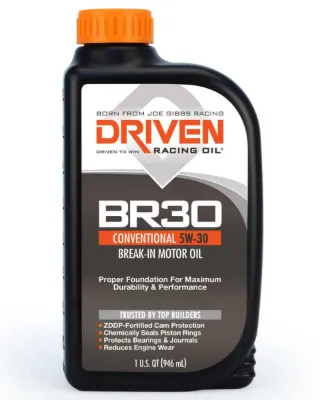
SKU DRIBR30
Driven BR - mineral break-in oil 5W-30
Break-in oil with very high content of zinc and phosphorus-based anti-wear additives. Provides maximum protection for the entire engine during break-in. Is of course compatible with Driven Assembly Grease and all the other oils from Driven Racing Oils. - Viscosity: SAE 5W-30 - 0.946 l.
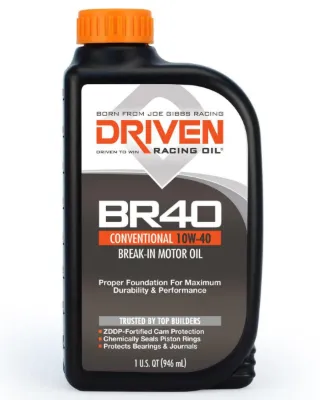
SKU DRIBR40
Driven BR - mineral break-in oil 10W-40
Break-in oil with very high content of zinc and phosphorus-based anti-wear additives. Provides maximum protection for the entire engine during break-in. Is of course compatible with Driven Assembly Grease and all the other oils from Driven Racing Oils. - Viscosity: SAE 10W-40 - 0.946 l.
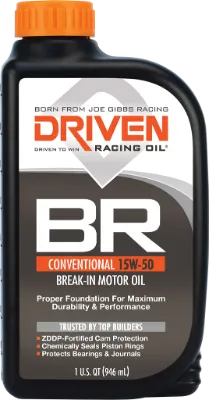
SKU DRIBR50X
Driven BR 15W50 mineral break-in oil
Break-in oil with a very high content of zinc and phosphorus-based anti-wear additives. Provides maximum protection for the entire engine during break-in. Is of course compatible with Assembly Grease and all the other oils from Driven Racing Oils.