
Guide
Chips and cutting oil after machining — why the parts must be washed
A part can be machined to within a hundredth and still be scrapped. What sinks it is the chip the oil holds in place. Here is what happens, where it goes wrong, and how to choose a washing method by how many parts you make.
If you read one thing
After turning, milling and drilling there are always chips left on the part — and the cutting oil glues them in place. A single chip in a threaded hole skews the tightening torque at assembly; one under the paint gives blisters and flaking in the curing oven. That is why washing is a production step of its own, not a tidy-up at the end. Rule of thumb: many similar parts every day are washed best in an automatic hot-water washer with a rotating basket; few and complex parts are washed better by hand in a high-pressure booth. Always wash BEFORE assembly and BEFORE paint — never after.
Updated 11 September 2026
Three chip forms, three different problems
Everything cut in metal makes chips. What the chip looks like decides where it ends up and how easy it is to get rid of.
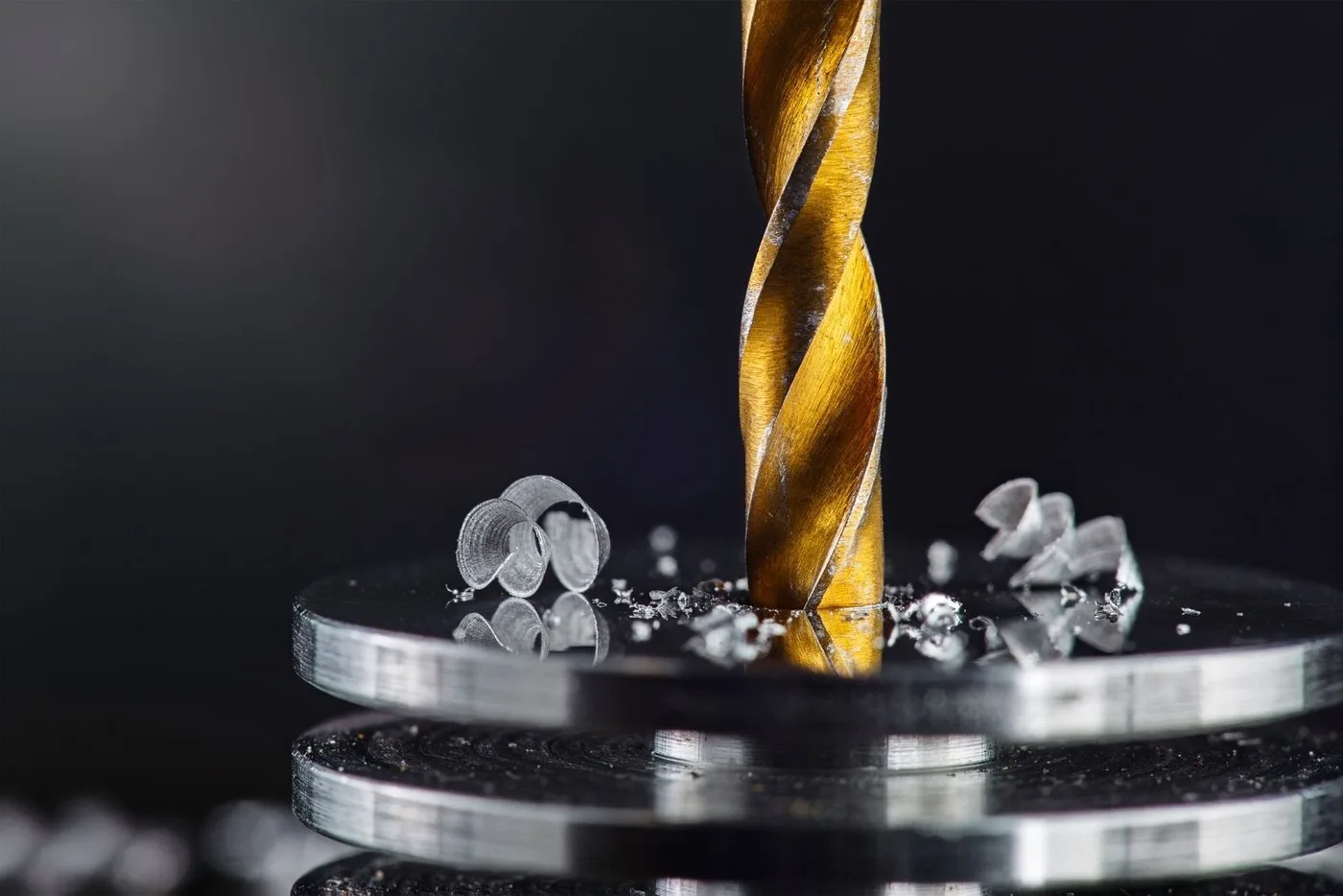
Discontinuous chips break off one by one, like small flakes. They are easy to remove from open surfaces — and just as easy to lose into holes and pockets, where they stay.
Segmented chips hang together in short pieces with cracks between them. They tend to lodge in edges and threads, and a single segment can break loose long after the part is finished.
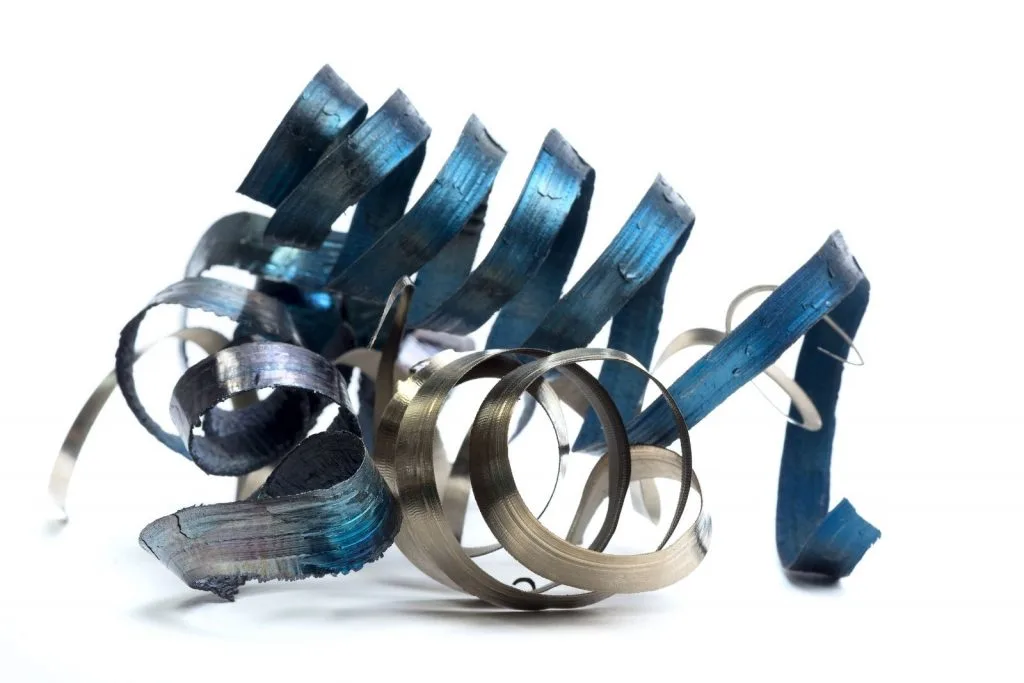
Continuous chips come as unbroken ribbons or spirals. They look dramatic, but are actually the easiest to handle: they are big enough to see, and they rarely stay inside the part.
It is the first two that cost money. They are small, they are sharp, and they are coated in oil.
Why the oil holds the chip in place
Cutting oil and coolant have one job during machining: lubricate and cool. Afterwards they do a second job nobody asked for. The liquid draws itself into every narrow gap — between chip and surface, into thread roots, down blind holes. That is capillary action: the narrower the gap, the harder the liquid holds.
The result is that the smallest chip, the one you can least see, sits tightest. Compressed air does not move it; it lies in an oil film thicker than the chip itself. A rag pushes it around. The only thing that frees it is removing the oil it lies in — which is why washing with hot, water-based detergent works where blowing does not.
Neat oil without water is worst. It is more viscous than emulsion, does not evaporate, and never dries out. A part left for a week is as chip-laden as the day it left the machine.
Failure no. 1: assembly at the wrong torque
A bolt is tightened to a given torque because that torque gives the right stretch in the bolt. If a chip sits at the bottom of the threaded hole, or between the mating faces, the bolt stops against the chip instead of the face. The torque wrench clicks — at the right value — but the joint is loose. Nobody sees it on the bench. It shows up in service, as a screw that works loose or a seal that leaks.
In hydraulics it is worse. A chip that comes free after assembly becomes a sharp foreign particle in the oil. It scores cylinders, lodges in valves and damages gears. Then it is no longer one part that is scrapped, but a whole unit — usually at the customer.
Failure no. 2: paint that lets go in the oven
Paint and powder coating are meant to bond to the metal. If a chip with oil under it is in the way, the paint bonds to the chip instead. In the curing oven two things happen at once: the oil under the chip evaporates and lifts the coating, and the chip itself comes loose. What remains is blisters, small craters and cracks with bare metal at the bottom. That is where the rust starts.
It does not stop there. Chips that follow the part into pretreatment — degreasing, phosphating, rinsing — end up in the baths. There they contaminate the chemistry for every part that follows, and the bath has to be drained and refilled off schedule. One badly washed batch can spoil the next ones.
Where in the flow the wash belongs
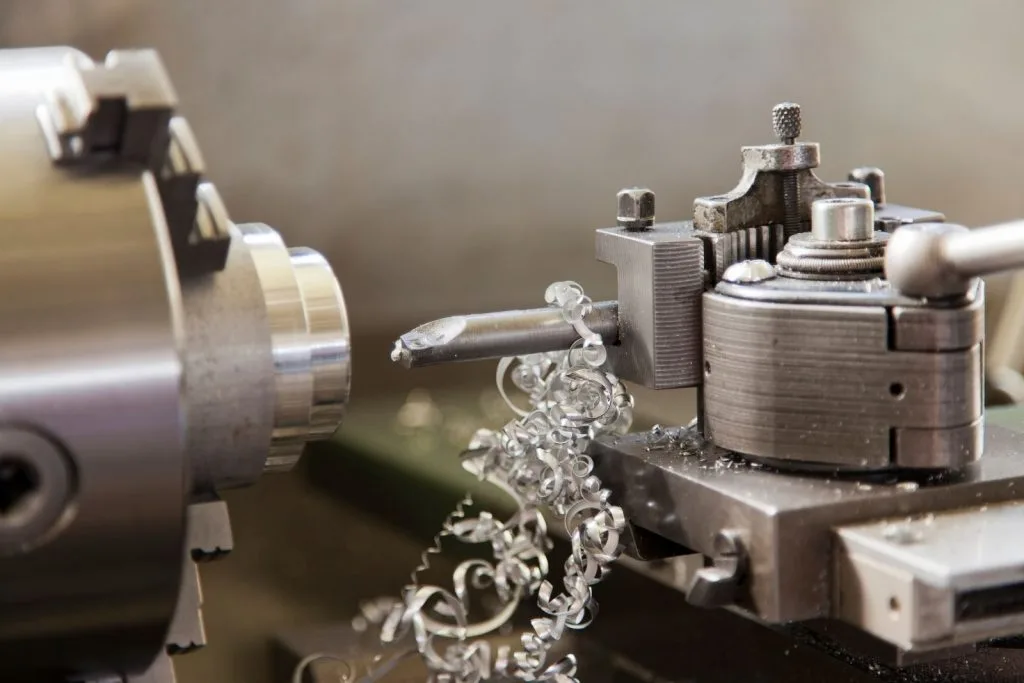
Machining happens in two phases. Roughing removes a lot of material fast, with no accuracy requirement. Finishing brings the part to size and surface. The chips from finishing are small and sharp, and those are the ones left in the part when it is done.
So the rule is simple: wash after the last machining operation, and before the next step that depends on a clean surface. That means before assembly, before paint, before brazing, before bonding, and before any measurement that is to be documented. A wash done "at the end, if we have time" is in practice no wash.
If the part is to be both assembled and painted, it is washed once — after machining, before both. And it is stored dry and covered in between, so it does not collect new oil and new dust.
Automatic or manual booth — choose by quantity
There are two main routes, and the choice is rarely about which washes best. It is about how many parts you make per day, and how alike they are.
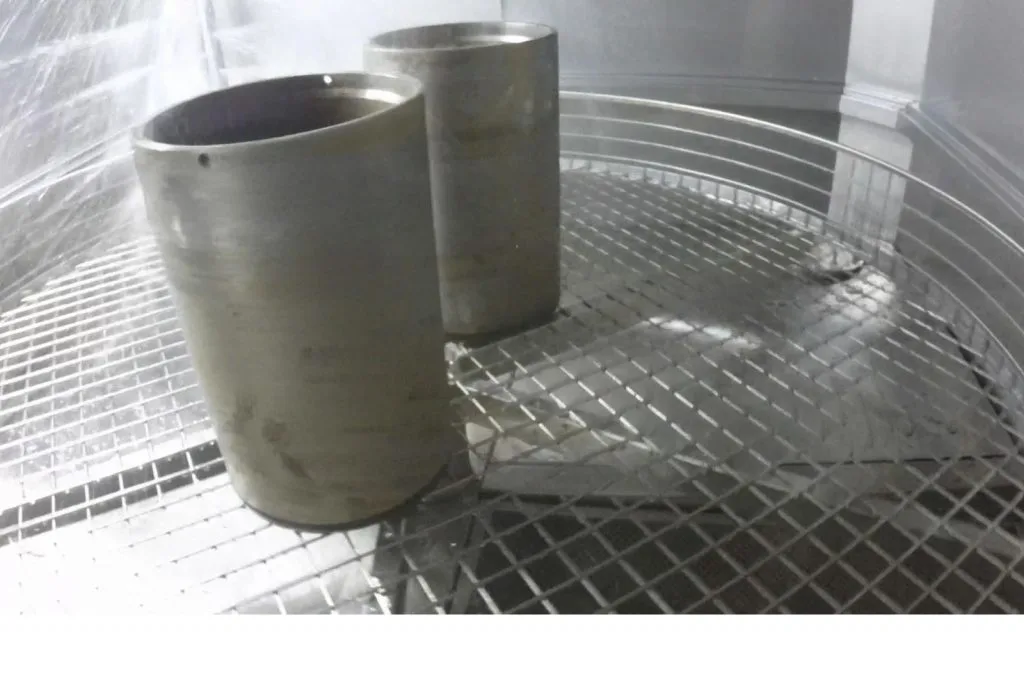
Automatic hot-water washer with a rotating basket. The parts go in the basket, the lid closes, and hot water-based detergent is sprayed from fixed nozzles while the basket turns. Every side is hit, nobody stands holding a gun, and the machine runs while the operator does something else. That is the right answer when batches come out of the machine shop every day — similar parts, many of them, where the wash should take the same time every run. The upper limit is set by the basket diameter and load capacity, not by the count.
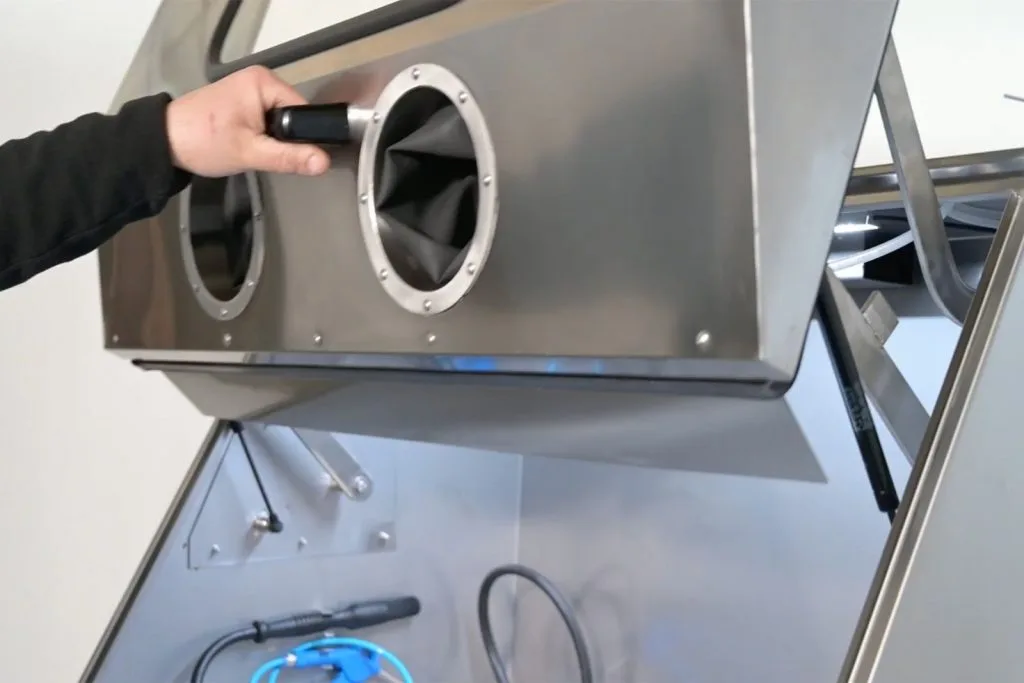
Manual high-pressure booth. The operator works with gloved hands through the cabinet wall and directs the jet themselves. Slower per part, but precise: a blind hole with a chip at the bottom gets the jet straight down the hole, and a part with delicate faces can be shielded. That is the right answer for few and different parts — prototypes, repairs, large one-offs — where an operator has to look at each part anyway.
To be honest: we sell the automatic washers. Manual high-pressure booths are not in our catalogue today. But if you make a few dozen complex parts a week, the booth is still the right answer, and we would rather say so than sell you an automatic washer you cannot keep full.
What an automatic washer actually does
Three things free chips and oil in an automatic washer, and all three have to be in place.
Heat. Hot water makes the oil thin. Thin oil lets go of the chip, and the detergent gets to work. That is why the tank is heated, and why a cold washer never gives the same result.
Volume, not just pressure. It is the amount of water through the nozzles that flushes the chip away — pressure alone only moves it around. A pump delivering many litres a minute through many nozzles gives a flood that carries off everything loose.
Rotation. The basket turns so every part is hit from all sides, including sides an operator would not reach. Tubes, sleeves and parts with holes get the jet into the opening on every revolution.
Finally: everything rinsed off ends up in the tank. The chips sink and are caught in a strainer; the oil floats up and can be skimmed off. That is how the water stays usable for a long time, and how a full strainer becomes the signal that it is time to empty.
Example: Washer 1150 E Power in numbers
| Load capacity | 400 kg |
|---|---|
| Pump flow | 150 litres/min at 4.5 bar |
| Nozzles | 64 |
| Basket | Ø 1130 mm, 550 mm working height |
| Tank | 210 litres, heated |
| Temperature | Up to 60 °C |
| Material | Stainless steel AISI 304 |
Watch out for
Blind holes and threaded holes. That is where the chip hides. Place the part in the basket so the holes point out or down, not up — then the water drains out again instead of standing with the chip in it.
Overfilled basket. Parts lying on top of each other shield each other from the jet. The load capacity says what the basket can carry, not what gets clean. Load in one layer when you can.
Cold tank. A washer that has not heated up washes poorly and takes longer. Start the heating before the shift begins, not when the first basket is ready — a timer on the machine does it for you.
Dirty tank. When the strainer is full and the oil layer thick, the parts are being washed in old oil. Set fixed intervals for emptying, and log them.
Flash rust. A freshly washed steel part is chemically clean and completely unprotected. Dry it, and give it corrosion protection if it is not going straight on to the next step.
Not sure which washer suits your production?
Tell us what you make, how many per day, and how big the largest parts are. We will find the right basket size and load capacity — or tell you if a manual solution is the right one.
Contact usThe equipment this is about
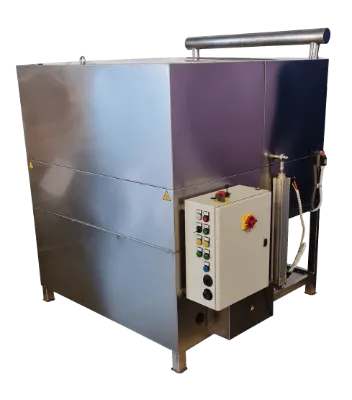
SKU GEIP400181
Automatic Parts Washer 1150 X
The Washer 1150 X is an automatic parts washer in AISI 304 stainless steel, designed for washing small and medium-sized parts using heated water-based detergent at a maximum temperature of 60 °C. It features an integrated heated detergent tank, a load capacity of 800 kg, and a rotary basket with washing ramps in AISI 304 stainless steel. Power supply is 400 V three-phase.
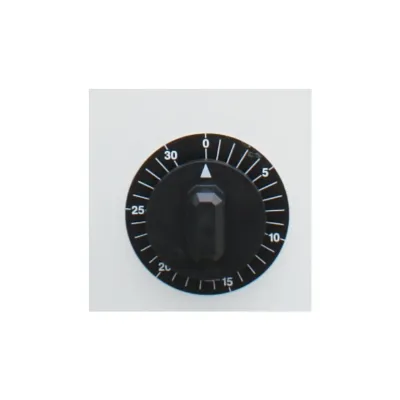
SKU GEIG0031
Complete Washer Timer
Complete replacement timer for Geicos automatic parts washers. Compatible with the following models: Washer 1150 E POWER, Washer EasyOne, Washer 900 E POWER, Washer Easy Four Pocket, Washer 1500 E POWER, Washer Up & Down 2000 Power, Washer Up & Down 1450 Power, Washer 60, Washer 1800 E POWER, Washer 750 E POWER, and Washer Easy Four.
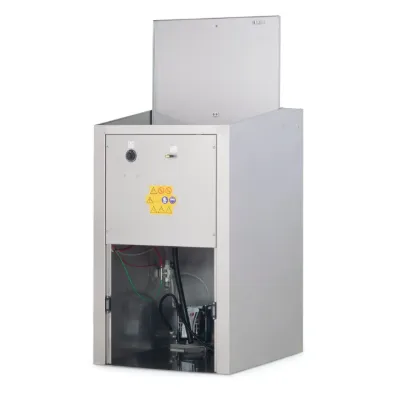
SKU GEIP300251
Top Tinwash Automatic Parts Washer
Top Tinwash is an automatic parts washer in AISI 304 stainless steel, designed for washing small and medium-sized parts using a solvent-based detergent. The machine uses a service drum with a load capacity of 50 kg and is pneumatically powered.
SKU GEIP400091
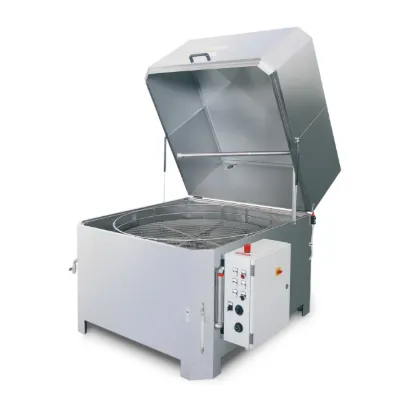
Washer 1150 E Power – Automatic Parts Washer
The Washer 1150 E Power is an automatic parts washer in AISI 304 stainless steel, designed for automatic washing of small and medium-sized parts. Washing is carried out with heated water-based detergent at a maximum temperature of 60 °C. The machine features an integrated heated detergent tank and a sustainable load of 400 kg. Power supply is 400 V three-phase. The rotary basket and washing ramps are made from AISI 304 steel.
SKU GEIP400151
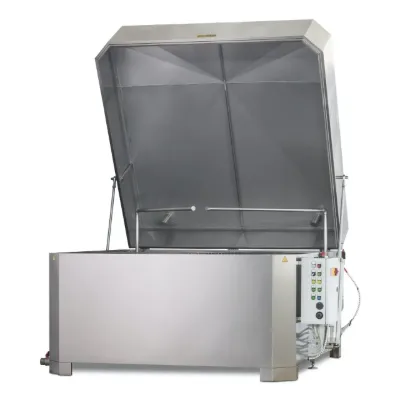
Washer 1800 E Power – automatic parts washer
The Washer 1800 E Power is an automatic parts washer in AISI 304 stainless steel, designed for washing large-sized parts. Washing is carried out with heated water-based detergent at a maximum temperature of 60 °C. The machine features an integrated heated detergent tank, a maximum load capacity of 400 kg, and a rotary basket with washing ramps in AISI 304 steel. Power supply: 400 V three-phase.
SKU GEIP400141
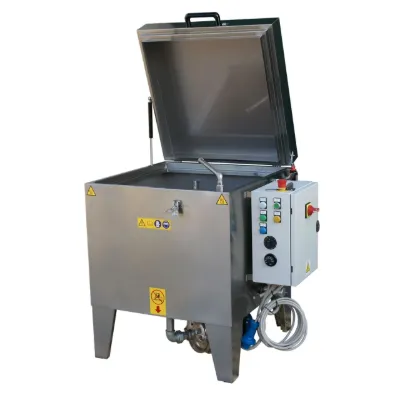
Washer 60 – Automatic Parts Washer
The Washer 60 is an automatic parts washer in AISI 304 stainless steel designed for automatic washing of small and medium-sized parts using heated water-based detergent, with a maximum temperature of 60 °C. It features an integrated heated detergent tank, a load capacity of 100 kg, 230 V mono-phase power supply, a rotary basket and washing ramps in AISI 304 steel.
SKU GEIP400161
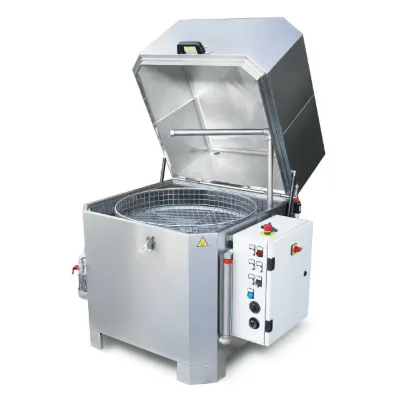
Washer 750 E Power – Automatic Parts Washer
The Washer 750 E Power is an automatic parts washer in AISI 304 stainless steel, designed for automatic washing of small and medium-sized parts using heated water-based detergent. Maximum temperature 60 °C. Integrated heated detergent tank with a sustainable load of 400 kg. The machine operates on a 400 V three-phase power supply and features a rotary basket and washing ramps in AISI 304 steel. Parts are washed by high-pressure water-based detergent.
SKU GEIP400101
Washer 900 E Power – Automatic Parts Washer
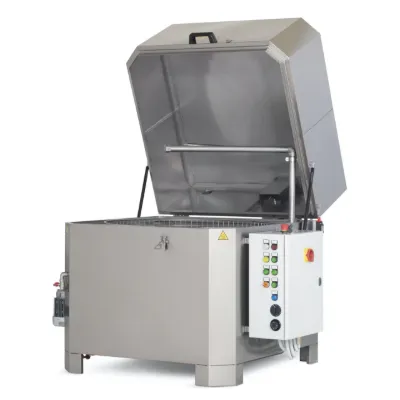
The Washer 900 E Power is an automatic parts washer in AISI 304 stainless steel, designed for automatic washing of small and medium-sized parts using heated water-based detergent. Maximum working temperature is 60 °C. The machine features an integrated heated detergent tank and supports a load of up to 400 kg. Power supply is 400 V three-phase. The machine is equipped with a rotary basket and washing ramps in AISI 304 steel. Washing is performed at high pressure using water-based detergent.
SKU GEIP400201
Washer Easy Four Automatic Parts Washer
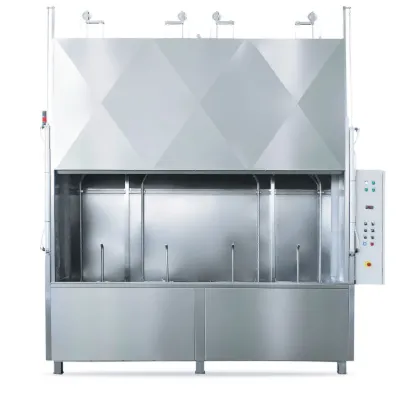
The Washer Easy Four is an automatic parts washer in AISI 304 stainless steel, designed for the automatic washing of four drums of different sizes simultaneously. Washing is carried out with heated water-based detergent at a maximum temperature of 60 °C. Integrated heated detergent tank. Washes drums from 30 up to 250 litres. 400 V three-phase power supply. Washing ramps in AISI 304 steel. Available in two variants (P40020.1 and P40020.2).
SKU GEIP400102
Washer Easy Four Pocket
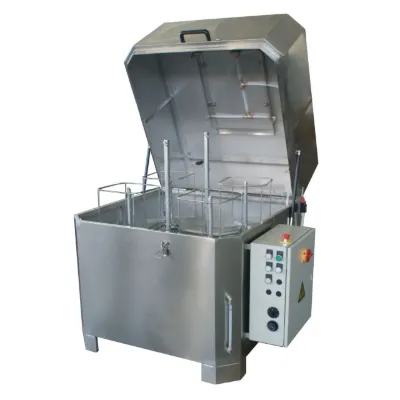
The Washer Easy Four Pocket is an automatic parts washer in AISI 304 stainless steel, designed for the simultaneous automatic washing of 4 tanks of different sizes. Washing is carried out with heated water-based detergent at a maximum temperature of 60 °C. The machine features an integrated heated detergent tank, 400 V three-phase power supply, and washing ramps in AISI 304 steel.
SKU GEIP400092
Washer EasyOne
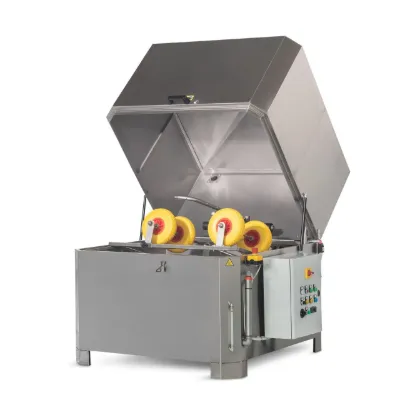
The Washer EasyOne is an automatic parts washer in AISI 304 stainless steel, designed for the automatic washing of one drum at a time in different sizes. Washing is performed with heated water-based detergent at a maximum temperature of 60 °C. Suitable for barrels from 30 up to 250 litres. The machine features an integrated heated detergent tank, rotary basket and washing ramps in AISI 304 steel. Power supply: 400 V three-phase.
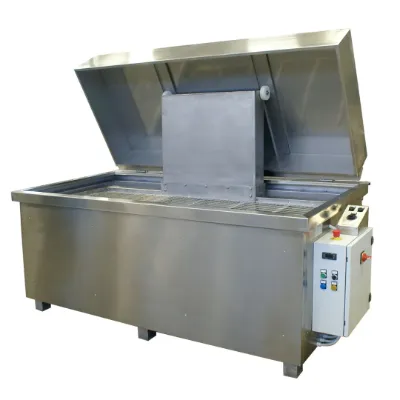
SKU GEIP400132
Washer Up & Down 1450 Power
The Washer Up & Down 1450 Power is an automatic parts washer in AISI 304 stainless steel designed for automatic washing and shaking of small and medium-sized parts. Washing is carried out with heated water-based detergent at a maximum temperature of 70 °C. Integrated heated detergent tank. Sustainable load: 150 kg. 400V three-phase power supply. Rotary basket and washing ramps in AISI 304 steel.