
Guide
Torque seal — the stripe that exposes loose bolts
The cheapest quality-assurance tool in the whole workshop: a stripe that tells the truth about every bolted joint.
If you read one thing
Torque seal is a small stripe of indicator paste laid across the nut and the surface after the joint is torqued to spec. If the stripe is unbroken, the bolt stands as you left it; if it is broken or offset, something has moved — or someone has been turning it. Seconds to apply, and the whole inspection happens at a glance. Used everywhere from aviation and machining to maintenance rounds on the workshop floor.
Updated 29 August 2026
What torque seal is — and what it is not
Torque seal is a fast-drying indicator paste in a tube. After a bolt or nut is torqued to spec, you lay a narrow stripe crossing both the nut and the surface behind it. Once dry, the paste is brittle: if the joint moves, the stripe breaks — and the break is visible from metres away.
It is worth being precise about what it is not: torque seal is not threadlocker. It prevents nothing from loosening — it reveals that it has happened. The locking is the torque wrench's, the threadlocker's or the lock nut's job; the stripe is the receipt and the alarm.
How to use it
1. Torque first. The stripe confirms a finished joint — torqued to spec, with a torque wrench where required.
2. Clean and dry. Wipe oil and dirt where the stripe will sit; the paste bonds poorly to grease.
3. One narrow stripe across. From the nut or bolt head onto the surface behind it, in one motion straight from the tube. It must cross the joint line — the line is what betrays rotation.
4. Let it dry. After a few minutes it is touch-dry and brittle enough to do its job.
5. Inspect at a glance. On the maintenance round you need no tools: unbroken stripe = untouched joint. Broken, offset or missing stripe = stop and find out why — vibration, settling or unauthorised turning.
See torque seal in use on nuts and bolts
Where it earns its keep
Vibration-exposed joints: machine bases, fans, compressors, vehicles and everything else that shakes — the stripe is the earliest warning that a joint is working loose.
Assembly quality assurance: an assembled unit where every torqued bolt carries a stripe can be final-inspected at a glance — and the stripe documents that the torquing was actually done.
A tell-tale against unauthorised turning: on equipment where adjustment must be controlled — relief valves, calibrated settings, sealing — a broken stripe shows someone has been there. That is why aviation has used the method for generations.
The colours have a job: pick a colour that contrasts with the part — and if the workshop uses several colours systematically, the colour can code who torqued, or when.
Want stripes on your maintenance round?
Tell us the equipment and environment, and we will help you with colours and the rest of the marking kit.
Contact usThe equipment this is about
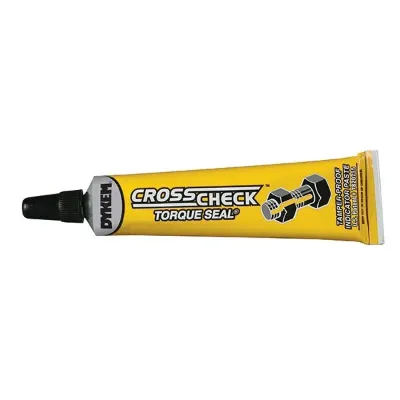
SKU DYK833X
Dykem Cross Check - marking dye for threaded connections
With Dykem Cross-Check you can tell if nuts have loosened! Movement from vibration or tampering shows up clearly in the seal.
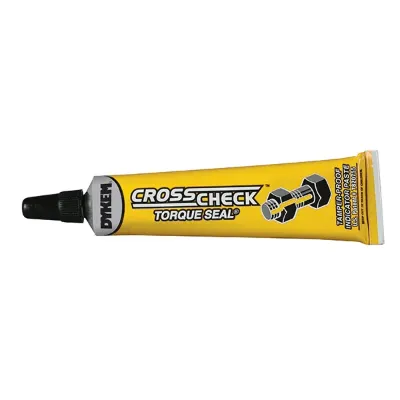
SKU DYKCC-GUL
Dykem Cross Check - Yellow
With Dykem Cross-Check you can tell if nuts have loosened! Movement from vibration or tampering shows up clearly in the seal.